Consider a sodium ion in the extracellular fluid next to a neuron at its resting potential. The temperature of fluid in a healthy human brain is 39 Celsius, which means that the thermal energy contributed by each particle in that fluid is 3kT = 1.29*10^-20 Joules. The mass of a single sodium ion is 3.82*10^-26 kg, which means that it must be moving at v = sqrt(2 * (1.29*10^-20 Joules / 2) / (3.82*10^-26 kg)) = 581.1 m/s. This is astoundingly fast – if not acted upon by some other force, the ion would travel 5 football fields in 1 second!
But the ion is surrounded by H2O, which slows it down. It’s known empirically that in 1 liter of water, there are 55.5 moles of H2O. In other words, in each cubic decimeter of water, there are 55.5 * 6*10^23 = 3.3*10^25 H2O molecules, which means that the average spacing between H2O molecules is 10cm / (3.3*10^25)^(⅓) = 0.31nm. This can be interpreted as the average distance that the sodium ion travels before hitting an H2O, which means it’s hitting an H2O molecule once every 0.31nm / 581.1 m/s = 5.32*10^-13 seconds, or 1.87 trillion times every second. Assuming the steps are independent, a particle making 1.8 trillion steps each second with a step size of 0.31nm would be displaced by sqrt(1.8 trillion) * 0.31nm = 0.42mm every second, on average. However, empirically, sodium ions in water diffuse 0.05mm every second. The reason our derivation is incorrect is described below.
The diameter of an H2O molecule is 0.28nm, and as stated above, the spacing between each molecule is 0.31nm, so there is only 0.03nm of unoccupied space between H2O molecules. In a medium with such little free space, a sodium ion isn’t bouncing off of its neighbors as we assumed above; rather, it's in continuous contact* with its neighbors. Its kinetic energy comes primarily from vibrating within the confines of the H2O particles that surround it, and its slow drift comes from occasionally making its way through the densely packed crowd of H2Os. Picture being at a rave, trying to push through a dense crowd of people, squeezing through tight gaps one by one, but remaining stuck most of the time, being pushed around by your neighbors. This is the life of the sodium ion.
The speed at which an ion displaces through water depends on the shape and size of the ion, and the temperature of the water. People generally measure this speed empirically, rather than try deriving it from first principles – fluid dynamics is too complicated to model accurately. The quantity which people use to describe displacement speed is called the diffusion coefficient, which measures how much area a particle diffuses over in a given amount of time. A sodium ion in water at 39 Celsius has a diffusion coefficient of 1.33*10^-5 cm^2/s, from which we can derive that, on average, it displaces by 0.05mm every second [x^2 = 2Dt; x = sqrt(2 * 1.33*10^-5 cm^2) ~= 0.05mm] along an arbitrary single dimension. Here is a table of displacement vs time for the sodium ion:
| Distance | Time |
|---|---|
| 1nm | 0.4ns |
| 20nm | 0.15us |
| 1um | 0.4ms |
| 100um | 4s |
| 1mm | 6min |
Note that Time = O(Distance^2), so ions move short distances disproportionately faster than long distances.
Now let’s zoom out a bit. H2O and sodium ions comprise 99.46% and 0.26% of the molecules in extracellular fluid, respectively. The remaining 0.28% includes chloride, bicarbonate, urea, glucose, potassium cations, lactate, calcium and magnesium. Since there are 180 times fewer non-H2O molecules than H2O molecules, we can say the average spacing between non-H2O molecules is (180)^(⅓) = 5.8 times greater than the spacing between H2O molecules, ie ~1.8nm on average. Given the 0.28nm diameter of H2O, this means there are only ~6-7 water molecules on the line segment between a given sodium ion and its nearest neighboring non-H2O molecule. Is this close enough for the sodium ion to exert a noticeable electromagnetic force on its neighbors, and vice versa?
H2O molecules have no net charge, but they are polar: the side with oxygen is negatively charged, and the side with two hydrogens is positively charged. Because of this, H2O reorients itself to point its oxygen side towards positively charged ions:
… [H+ O-] [H+ O-] [H+ O-] [Na+] [O- H+] [O- H+] [O- H+] …
Since H2O molecules have no net charge, this reorientation doesn’t affect the electric field outside the body of water in which the sodium ion is suspended, but within the body of water, the electric field changes – for example, the electric field outside the innermost shell of oxygens but inside the innermost shell of hydrogens is much weaker than the electric field inside the innermost oxygens. At a macroscopic scale, the field induced by the reorientation of water molecules decreases the magnitude of the field of charges in the water by a factor of 78, on average – this is an empirical measurement. This effect is called dielectric screening, and the factor of 78 is called the relative permittivity of water. A dielectric is an insulator (a material whose structure prevents charges from moving through it easily) whose charges rearrange slightly in response to an electric field. The more polar a material is, the more it can rearrange in response to an electric field, and the more strongly it can screen the field of charges suspended within it. Water’s relative permittivity of 78 is quite high, because H2O molecules are very polar and reorientable. Note that the direction of the electric field created by ions is unchanged; only the magnitude is decreased. Now, we can use Coulomb's law to get the electric potential energy of a charge 2nm away from a sodium ion in water: electric potential = (1 / (4*pi*e_0))*e_r*(e^2 / r) = (8.99*10^9 / 78)*(1.602*10^-19)^2 / (2*10^-9) = 1.48*10^-21 J. Compare this to the thermal energy we computed above: 1.29*10^-20 J. So: after dielectric screening, the energy exerted by charged ions on their neighbors is ~10% of the energy of thermal motion. Not nothing, but small in comparison: random motion dominates; drift is a small component.
Screening affects sodium ions differently than it affects potassium ions. From Coulomb’s law, we know that the electric field at the surface of a sodium ion is e/(4πε₀r²) = (8.99*10^9) * (1.6 * 10^-19) / (0.95 * 10^-10) = 1.6 * 10^11 N/C. Similarly, the electric field at the surface of a potassium ion is (8.99*10^9) * (1.6 * 10^-19) / (1.33 * 10^-10) = 8.1 * 10^10 N/C. Notice that the force per unit charge at the surface of a sodium ion is twice that of the potassium ion, because sodium ions are smaller. As a result of this greater force, sodium ions get screened by more H2Os than potassium ions, enough that the effective size of a sodium ion moving through water is greater than that of potassium, because it binds more H2Os. This explains why the diffusion coefficient for potassium is greater than that for sodium despite potassium being bigger → the effective size of potassium after accounting for bound water molecules is less than the size of sodium ions, so it can move faster.
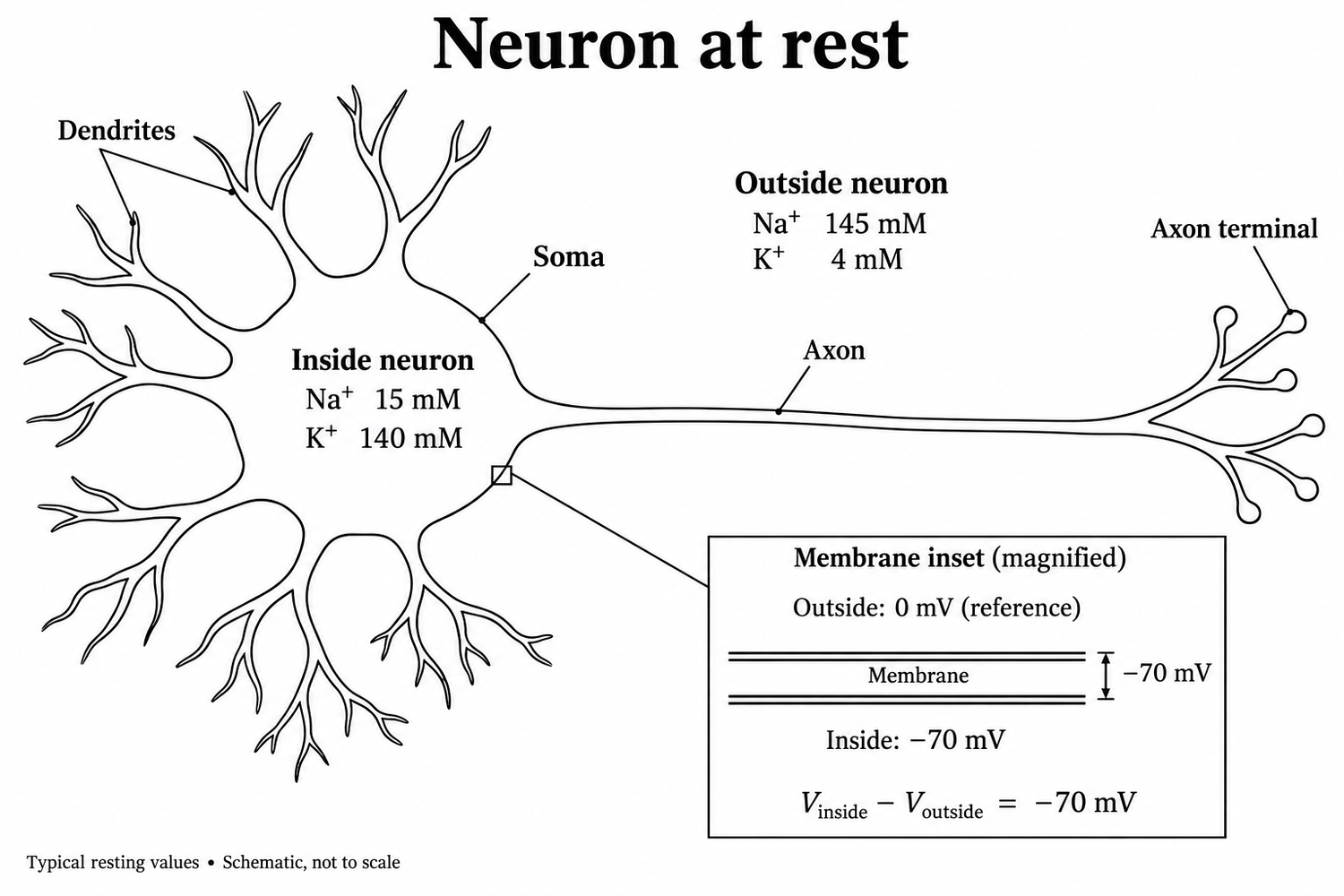
As the sodium ion diffuses through the extracellular fluid, it sometimes encounters a neuronal membrane, which is a lipid bilayer. The inside of lipid bilayers is hydrophobic, so in order for the sodium ion to pass through, it’d need to detach from the H2Os bound to it, which is extremely unlikely considering how strongly the sodium ion attracts H2O, so it rarely ever passes through. There are some special proteins lodged in the neuronal membrane which let sodium ions pass through, but when the neuron is at its resting potential, these channels are closed. In some rare instances, though, sodium ions hit the membrane with exactly the right orientation and energy to pass through. However, there are sodium-potassium ATP-ase enzymes lodged in the neuronal membrane which expel sodium ions and take in potassium ions in a 3:2 ratio, operating at roughly 100 Hz (so 300 sodium ions expelled every second). So even if a sodium ion finds its way into a neuron somehow, it is at risk of getting thrown out by the sodium-potassium ATP-ase enzyme. So when a neuron is at its resting potential, most sodium ions are outside the neuron and very few are inside.
The story is different for potassium ions. Neuronal membranes are filled with proteins which act as ion channels specifically for potassium. These proteins are constitutively open (meaning, always open, by construction) and are called selectively permeable because of a subtle structural detail that blocks sodium from going through even though potassium is let through. In short, the inside of the ion channels is lined with a carbonyl group (CO) with the oxygen facing the inside of the channel, so that the inside of the channel has a negative charge. The diameter of the channel is such that the smaller hydrated potassium ion can shed its hydration shell and replace it with the carbonyl groups without needing much energy, while passing through the channel, but the channel is still wide enough to not let the sodium ion through. As a result, potassium ions are able to flow in and out of neurons much more freely than sodium ions.
Motion of potassium ions in the extracellular fluid far from the neuronal membrane is dominated by randomness, as explained before. However, as the potassium ion approaches the neuronal membrane, the electric force it feels from sodium ions increases in the direction towards the neuron, because most sodium ions are outside of the cell, so from the perspective of the potassium ion, there are fewer sodium ions in the direction facing the neuronal membrane than in the opposite direction. This creates a lopsided drift for potassium ions into the neuron, which makes the concentration of potassium ions inside the cell greater than outside the cell. However, as the concentrations inside/outside become more lopsided, the tendency towards equal concentration everywhere (due to the second law of thermodynamics; entropy needs to increase) increases. At equilibrium, the electric force pushing potassium into the cell and entropy pushing them back out are equal. This occurs at -70mV of electric potential across the cellular membrane, and is called the resting potential of the neuron.
While a neuron is at its resting potential, sodium ions continue to leak into the neuron occasionally, and if there weren’t a sodium-potassium ATP-ase pumping them back out, the change in concentration would decrease the strength of the electric field keeping potassium ions inside the neuron. So the pump plays a crucial role in maintaining the concentration gradients necessary to hold a -70mV resting potential. The fact that the neuronal membrane is only permeable to potassium also plays a crucial role; even if all the pumps were turned off, the resting potential would be maintained for several minutes. So there are both a large dam (the neuronal membrane) and a small pump which work together to keep sodium from flooding in.
Here is a visual depiction of a neuron and the concentrations of Na+ and K+:
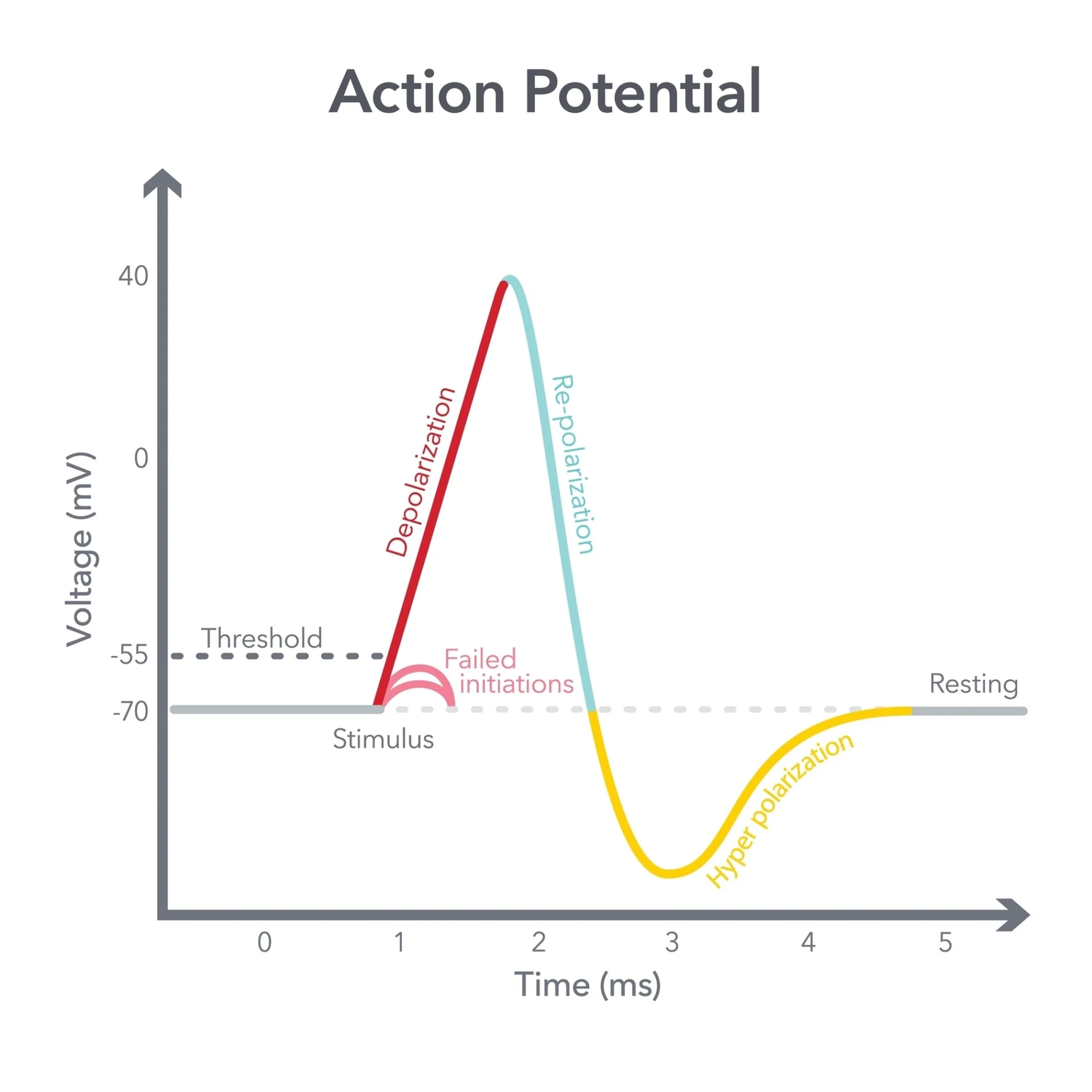
Sometimes, a special molecule moving through the extracellular fluid, called a neurotransmitter, attaches to a special protein embedded in the dendritic neuronal membrane, called a neurotransmitter receptor. Binding changes the shape of the neurotransmitter receptor in a way that creates a channel through which both potassium and sodium can enter the neuron. The sodium ions diffuse into the cell through those pores, since that is the direction of their concentration gradient (entropy), and the direction of electric potential. The sodium intake overwhelms the sodium-potassium ATP-ase pumps, and as a result, the electric potential across the neuronal membrane goes up (decreases in magnitude). This is the beginning of a process called depolarization. To get a sense of how many sodium ions rush in, let’s calculate how much charge separation is required to decrease the electric potential across the membrane by 1mV. The electric field between two sides of the neuronal membrane is E=q/(e_0*e_r), which is the formula for the field between two parallel charged plates [this can be derived by integrating Coulomb's law over the two plates]. The relative permittivity of hydrocarbons in the membrane is ~2, and the thickness of the membrane is 2nm, so we have V=Ed ; 1mV = 2nm * q/(e_0*e_r) ; q = 1mV * e_0 * e_r / 2nm , and dividing by the elementary charge, we get (8.854*10^-12 * 2 * 0.001) / (1.8*10^-9 * 1.602*10^-19) = 6.1*10^13 per m^2, or 61 ions per square micron, per millivolt. In other words, to depolarize the membrane from -70mV to 0, you’d need ~4200 sodium ions to diffuse from the outside in, per square micron. At resting potential, extracellular fluid has 145mM sodium, which means every cubic micron of extracellular fluid has ~87 million sodium ions. Hence, during an action potential, the concentrations of sodium / potassium barely change at all, but voltages change dramatically. Don’t picture an avalanche of sodium ions entering the neuron; picture a small instantaneous trickle.
The influx of sodium through neurotransmitter receptors triggers two kinds of previously-closed ion channels to open.
First, through a voltage-dependent protein mechanism, sodium ion channels open anywhere near parts of the neuronal membrane that depolarize to roughly -50mV. Since sodium initially comes in through the dendrites, sodium ion channels near the dendrites open first. Once those new sodium ion channels open, even more sodium rushes in through them, which opens sodium ion channels further downstream, which causes even more sodium to rush in, and so on. However, whenever a sodium ion channel is opened, a timer is set off to close it roughly 3ms later (again through a complicated protein mechanism which I won’t get into), so that the sodium ion channels close behind the newly opening ones. In this way, the depolarization event travels through the neuron, starting from the dendrites, through the soma, along the axon and finally into the axon terminal. The 3ms window in between opening and closing a sodium ion channel allows enough sodium to get through to depolarize the membrane to 40mV, not far from the equilibrium voltage of 60mV that would be reached if the sodium ion concentration gradient were allowed to balance against electric potential unencumbered.
Second, a timer is set off to open potassium ion channels. There were already many potassium ion channels open, but once these new ones open, the flow of potassium across the membrane increases by 10x, so that the concentration gradient of potassium flips back to dominating that of sodium, just like during the neuron’s resting potential. The beginning of this process is called repolarization. Eventually, potassium permeability increases so much that the cell over-corrects, and the electric potential goes down to -80mV. This overcorrection is called hyperpolarization. The potassium ion channels close a few milliseconds after they open, restoring the equilibrium between sodium/potassium concentration gradients and electric potential, so that the potential across the membrane is reset to -65mV.
Interestingly, concentrations of sodium/potassium inside/outside the cell barely change at all throughout this whole process, because, as calculated before, very tiny amounts of sodium flowing in/out of the cell are enough to create large changes in voltage.
Here's a plot of this entire process end-to-end: